Day 25, July 2nd, 2023
I leave Villar de Mazarife while it is still dark. And it begins right at the edge of town - the longest and straightest stretch of road I have ever seen! At first, I can't see the end of the road because it is dark, and later I can't see it because there isn't one, at least not for the next eight kilometres. Just imagine that - an asphalt road that runs completely straight for over eight kilometres. There are certainly longer ones somewhere on this world, but walking something like that really does something to you.
Beautiful but dreary
In the distance, lights are approaching. I assume it is a ca, but it just doesn't get any closer. Without exaggeration, it takes at least five minutes before I realise, it really is a car.
I am in the Páramo region, which translates roughly as treeless wasteland . All the places in this area have that del Páramo del Páramo in their name and are connected by such endless straight roads. Irrigation canals run everywhere, their loud croaking frogs announcing the day. The only turnings to the left and right are farm tracks with even more irrigation ditches running alongside vast plots of mostly grain fields. Looking at the map, I see there is a small bend at the end of the road, and then the same thing starts again for a similar distance. It is madness.
Nothing particularly exciting happens along this entire stretch of the road, apart from the thoughts that naturally crosses my mind and the realisation of just how long eight kilometres can be. The only thing I see is a dead otter on the roadside and a few other pilgrims, and only one car drives by the whole time.
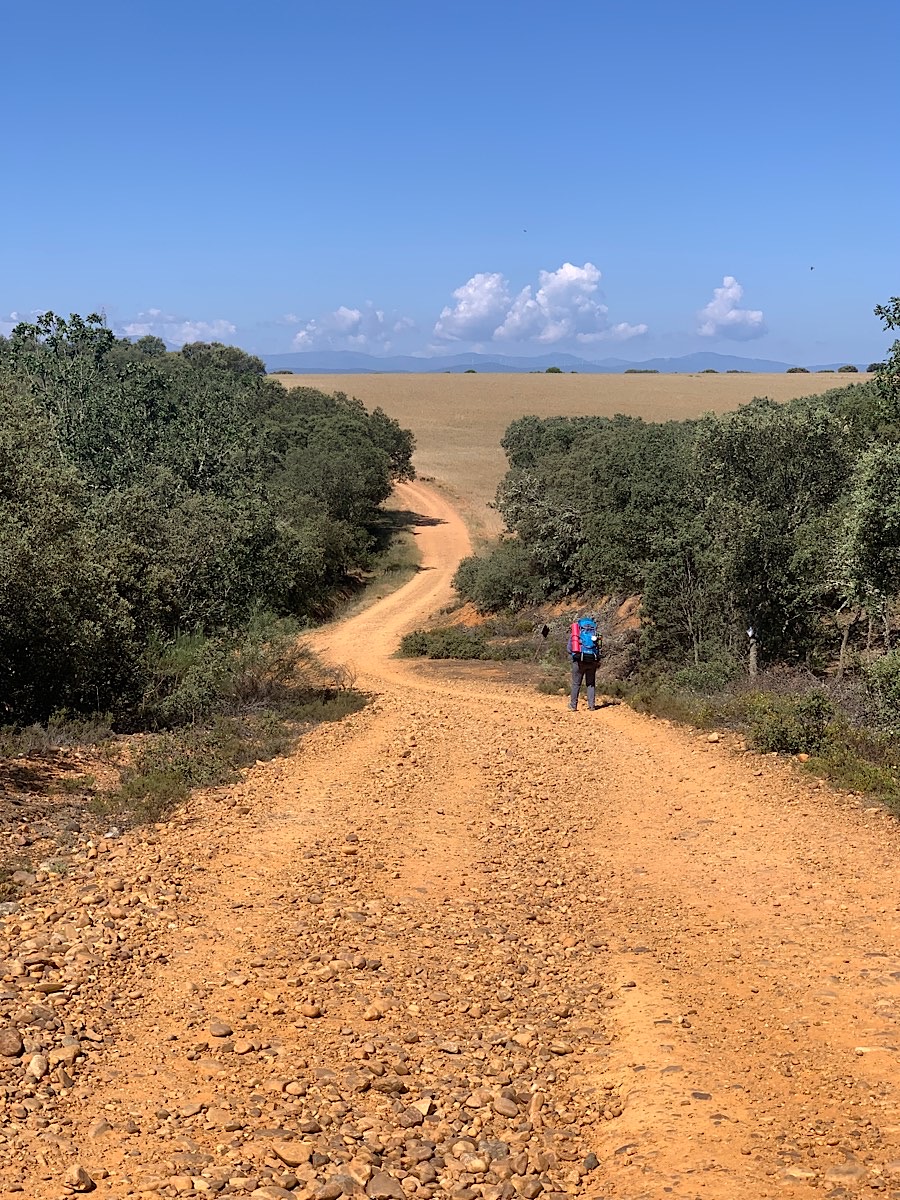
In the middle of the second long section, which by the way is no longer an asphalt road but a hard gravel track, I am supposed to turn right into the small village of Villavante. But at that moment it doesn't make sense to me to turn right only to end up back on the same path a short while later. This I only know because I have seen it on the map. So I simply continue straight ahead, saving myself a kilometre in the end. But when I finally reach a railway embankment that crosses the path, I understand the detour through Villavante where there is probably an official crossing that doesn't exist here. Now I have no choice but to trespass and scramble up the gravel bed and climb over the heavy tracks, because I am certainly not going all the way back.
In Puente de Órbigo I finally get my first coffee, something to eat and a stamp in my hiking pass. All this happens in a café with a wonderful garden in the back. The tables are set up under parasols among palm trees and free-range colorful chickens, I could sit here forever!
From now on the way is truly varied, but also more difficult to walk on due to the partially uneven ground. I can feel every single stone under my soles again. The sun is high in the sky with not a cloud in sight. It is such a beautiful path and I am thinking of nothing bad, when all of a sudden she appears in front of me, standing in the middle of the open countryside under a tree: the Spaniard-woman chatting with two others. My jar drops, but I am friendly and greet them all. The Spanish woman turns around, recognises me, and her jaw drops too. Oh well, nothing to be done about it, we are on the same way after all.
The Oasis
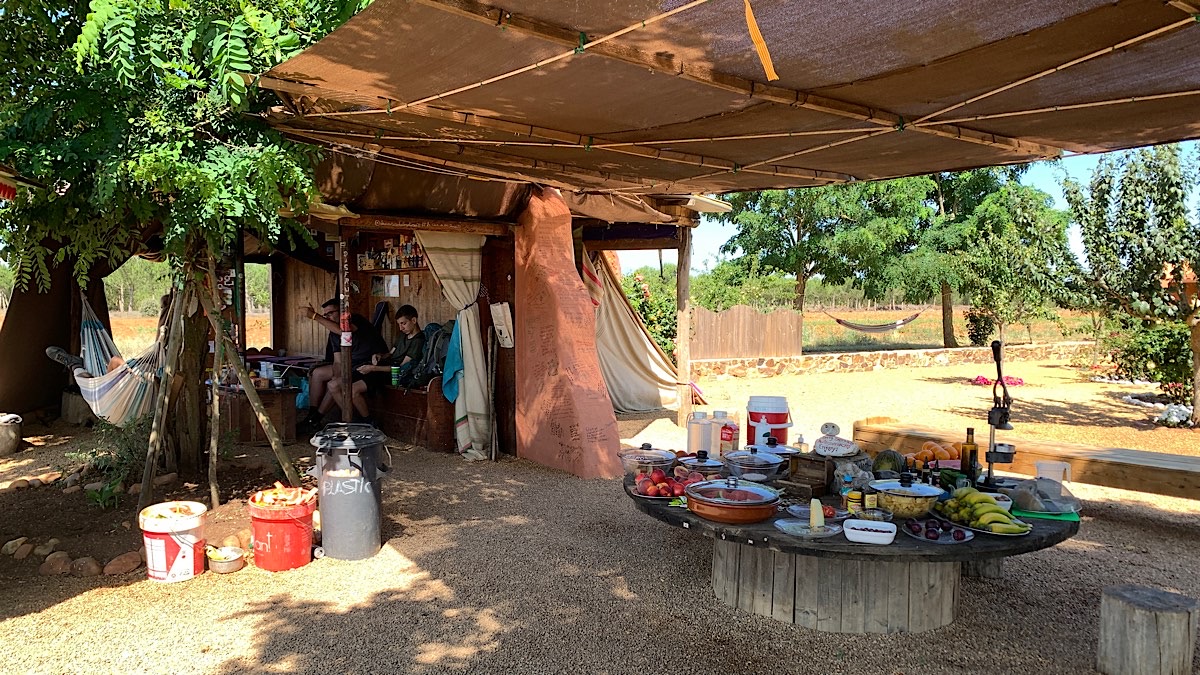
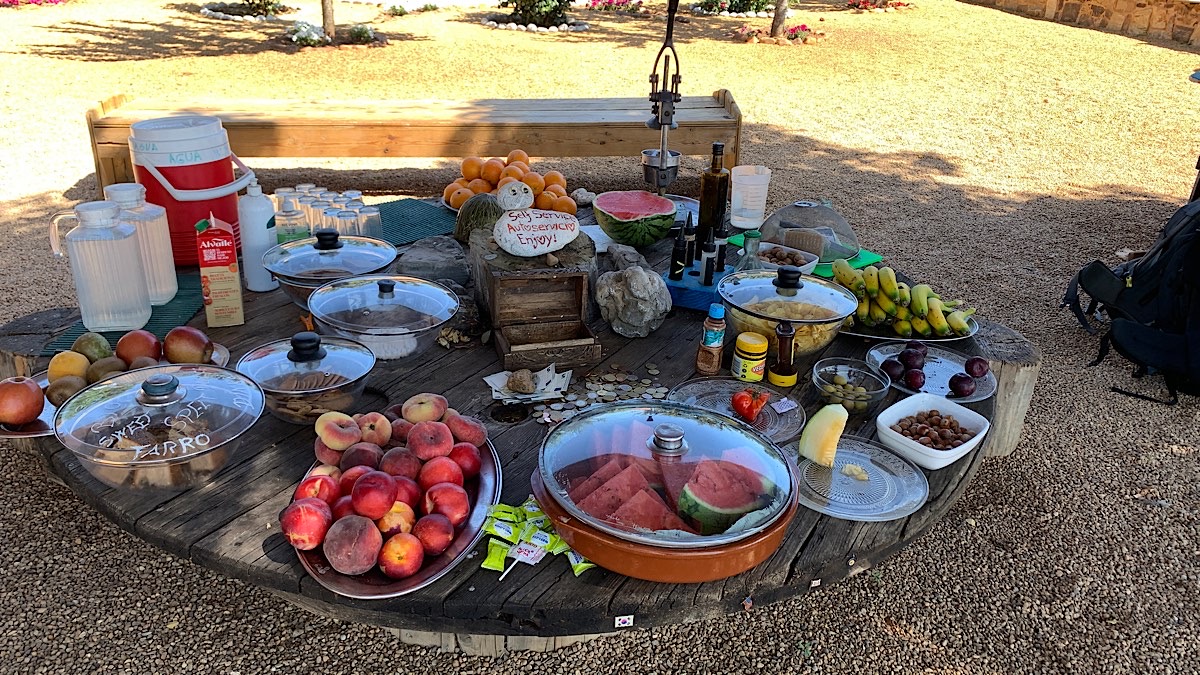
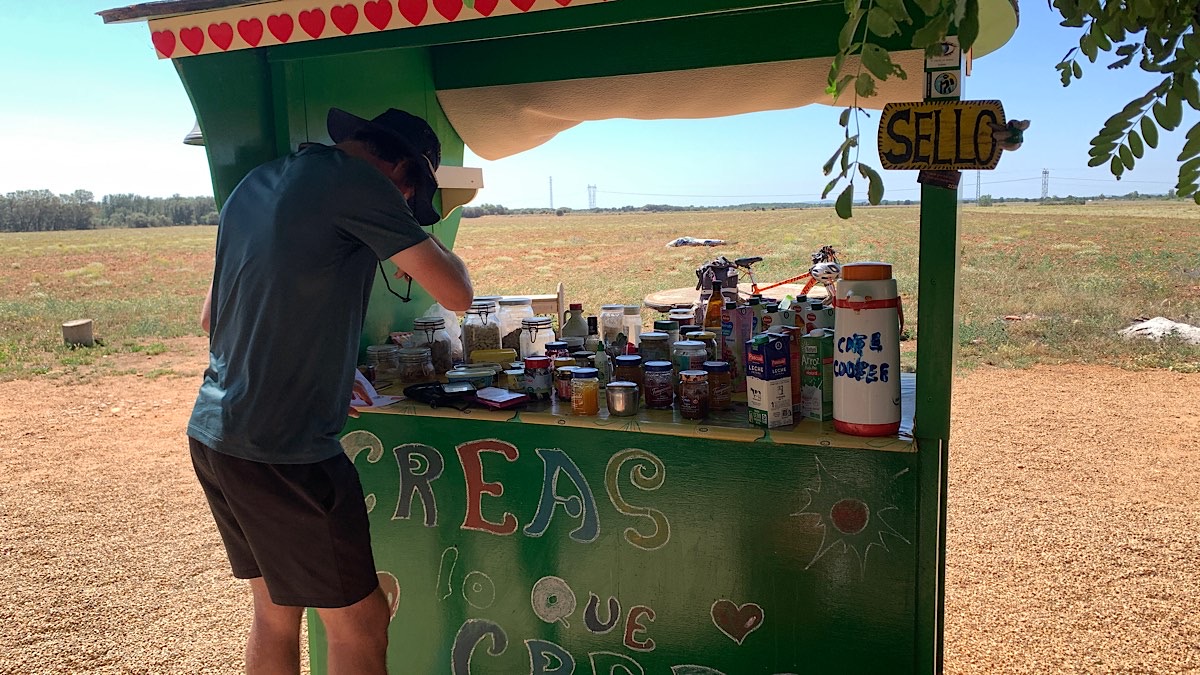
I am surrounded by wheat fields that stretch out widely, and wildflowers lining the path. I have already covered twenty kilometres and can easily manage another ten, even if I am not walking as briskly as I did this morning. Suddenly, in the middle of nowhere, there is a little oasis of well-being. A young man has settled here and created a charmingly rustic resting place for passing pilgrims. It is almost indescribable, so inviting and beautiful. In the center is a large table laden with all sorts of little treats like watermelon, biscuits, juices, cakes, fruit, potato crisps, and so on. You can help yourself to as much as you like and simply leave a donation in the middle of the table. Everything is so lovingly arranged, with hammocks and benches under shady trees next to brightly painted wooden huts where you can rest. What I couldn't possibly have guessed at that moment was that four hours after me, Angela would arrive and spend the night here, under the open sky, just on her sleeping mat in the middle of nature. How wonderful! If I had known she was coming, I would have stayed here too. I later learned from Angela that the young man‘s name was David, that he lived out here, and that the pilgrims' donations were his livelihood. David fetches the water he needs for himself and the pilgrims from a well quite a distance away in large canisters, which he laboriously hauls here several times a day.

La Mujer Española
The Spaniard-woman has arrived now too, and I glance over at her right as she bites into a piece of watermelon. As I soon figure out, she has helped a young woman along the way who seems to have broken her arm. This particular woman is here too and now being taken away by an ambulance. The Spaniard-woman is staying put. As ill luck would have it, she walks slightly ahead of me on the path a little while later with no other soul insight. If I walk quickly, she walks quickly, if I walk slowly, she walks slowly. Eventually I am just a tad behind her and about to overtake. Okay, I think, I can't just walk past her without a word, especially since we are walking almost at the same speed, forcing me to walk alongside her for a few metres. Let's see how she reacts when I speak to her politely.
»Hola!« I say friendly. She turns around.
»Hola«, she says too and immediately looks straight ahead again. She doesn't seem enthusiastic. Alright, second attempt.
»By the way, thank you for helping the young woman, this was very kind of you.« Now she smiles strainedly and tries to say a few words in English.
»woman not so bad, not broken arm, arm only out shoulder. Woman a little drama.«
That was pretty much it, though. At least no one can say I didn't try. I am sure she is a good person, in fact, I am convinced of it, but still, there is something there that doesn’t work with me, and she dislikes me just as much as I dislike her. Almost the entire day she seems to be somewhere near me, even though I really don‘t want to see her anymore, not even from behind.

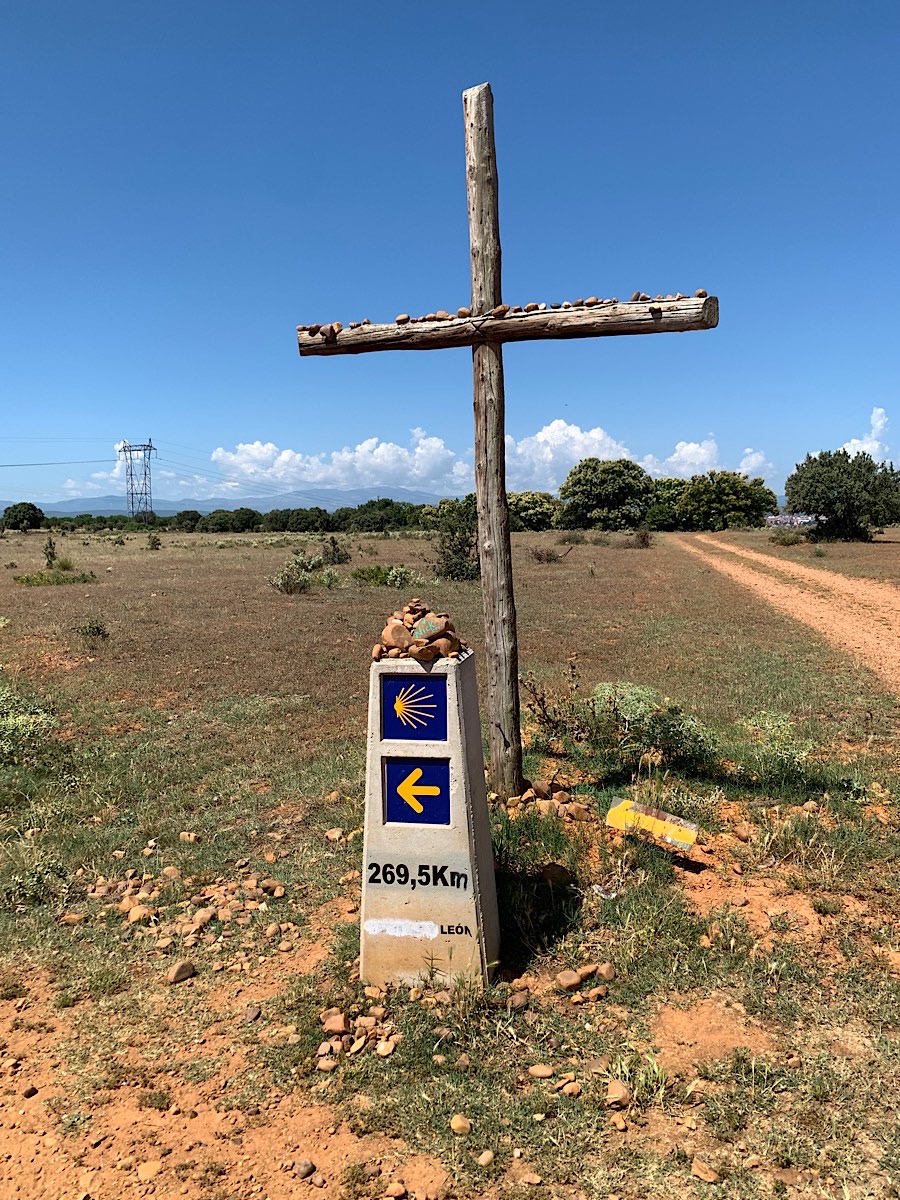
Just before Astorga my feet hurt so badly I can barely stand it anymore. On top of that, it is incredibly hot, a real ordeal. As the first outskirts of the city come into view, I have to cross a pedestrian bridge to get across a main road. This bridge zigzags uphill and then back down the other side in an equally long zigzag. It feels like walking five hundred meters for just ten meters. Once I reach the other side, I have to sit down on a rock in the shade of the bridge, I simply can't put any more weight on my poor feet. Two other pilgrims are sitting there. One of them has decided to end her Camino right here and is happy with her decision. I hope she stays that way and doesn't regret it later. I have to say, despite my excruciating pain, I am further than ever to giving up. I have reached a point where I can't imagine anything other than reaching Santiago de Compostela and just walking every single day. Following yellow arrows and not having to worry about anything other than where to get a cup of coffee and where I will sleep the next night has become part of my daily routine. I love it.
There she comes down the bridge, the Spaniard-woman. She doesn’t say anything, sits down on one of the rocks next to me and huffs and puffs, exhausted, in perfect social harmony with the rest of us. I interpret this as an accepted gesture of peace, perhaps her only way of saying, Hey, I‘m not so bad after all, and I am sure you're not eitherbecause the language barrier prevents any other form of communication. I can easily accept this thought and put the matter behind me. Incidentally, I never see the Spaniard-woman again after this point.
Astorga
My hostel is an old manor house dating back to the eighteenth century and is located next to the Cathedral of Santa Maria on the other side of town. There is a kitchen where you can cook and a cosy sitting area. The courtyard is darkened by laundry drying on clotheslines strung across the first floor from one window to the other. Up there are also the washrooms and dormitories divided by solid stone walls. My bunk bed is right next to one of these walls, and I am assigned the top mattress in a room full of overweight men whose language I don't understand. I am glad to be able to sleep next to a window that can be opened. And I will open it, so help me God.
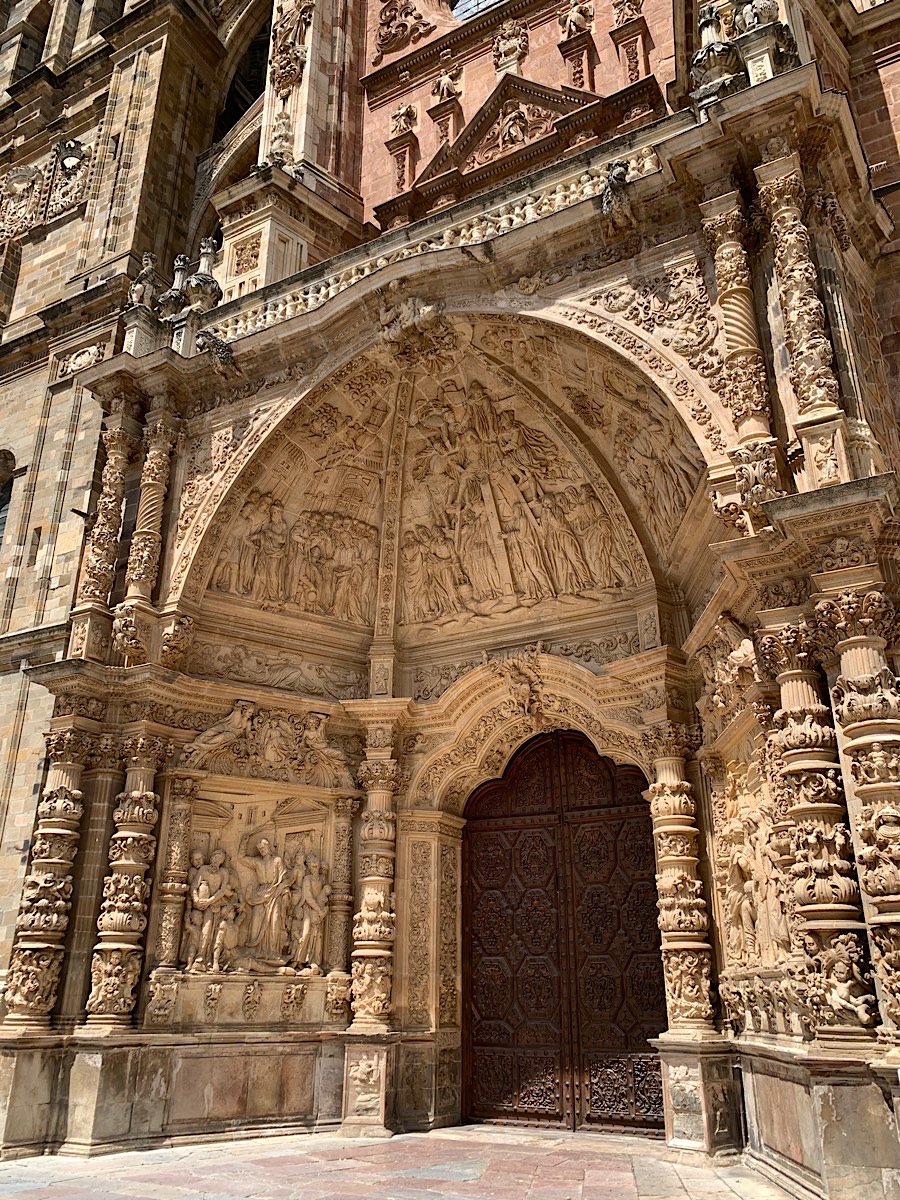
I am starving and find a restaurant within a short, albeit painful walk where I am having a mixed salad and fried potato slices with a spicy sauce, along with a large beer. It tastes delicious, and I finish it all. Fortified, I decide to wander around a bit as there is so much to see in Astorga. Besides sections of the original Roman city wall and the Plaza Mayor with its Baroque town hall, there is the Cathedral of Santa María, for example, whose construction began in the 15th century and which combines Gothic, Renaissance and Baroque elements. Or the Bishop's Palace, Palacio Episcopal, which now houses the "Museum of the Ways" and is dedicated to the history of the Camino de Santiago. If only it weren't for this relentless pain, and with every step my motivation to see anything at all dwindles. I would like to know how many pilgrims actually visit all the sights, let alone all the cathedrals. And those who do, don't any of them experience pain? Am I the only one who, by the end of the day, can only move on all fours? My legs don't even hurt, it's really just the soles of my feet that feel like they're riddled with shards of glass, which dig deeper into the red, swollen flesh with every step. My gluteal muscle, that bothered me so much at the beginning of my pilgrimage, are thankfully no longer an issue.
With an ice lolly in my hand, I hobble back to the hostel, lie down on my bed and fall asleep. How hot it is again. Later, clouds gather, and I hear the rumble of thunder in the distance.
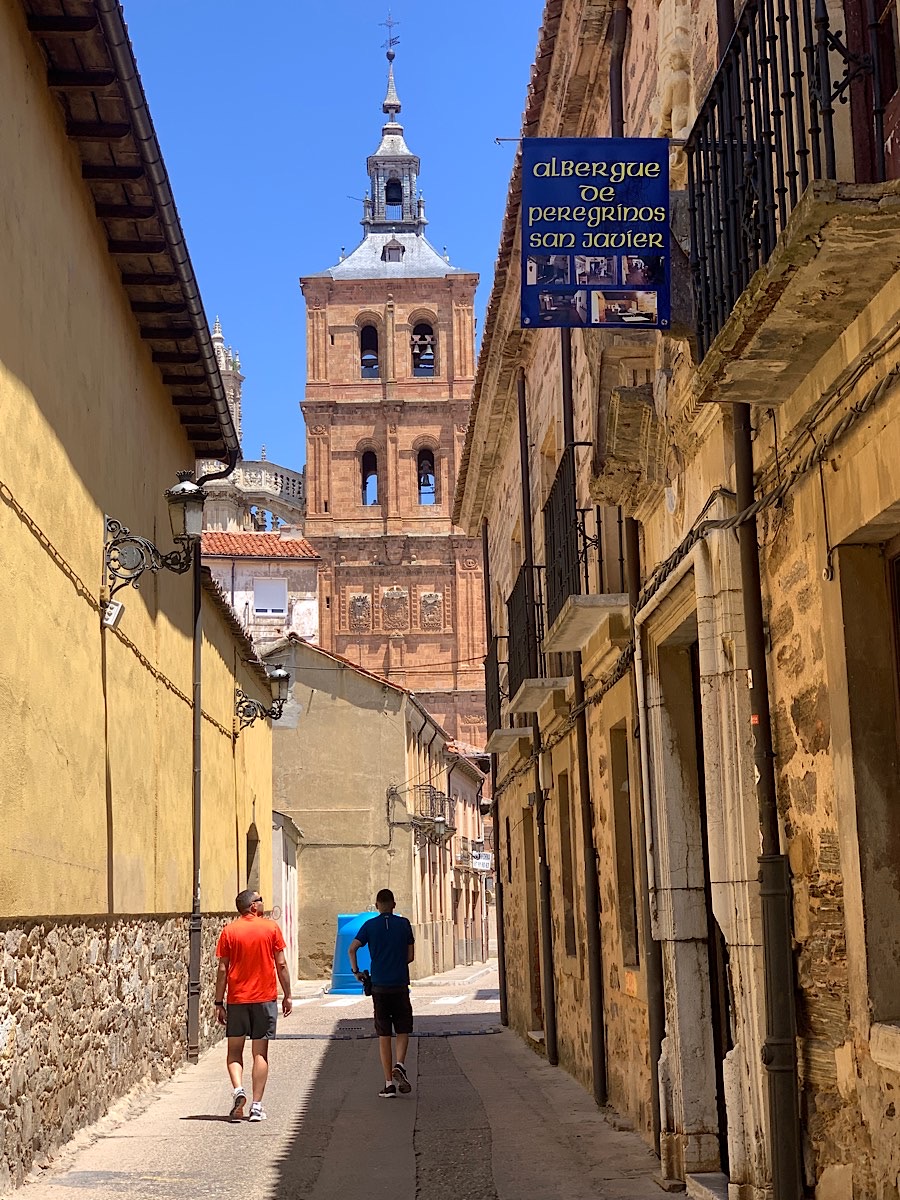
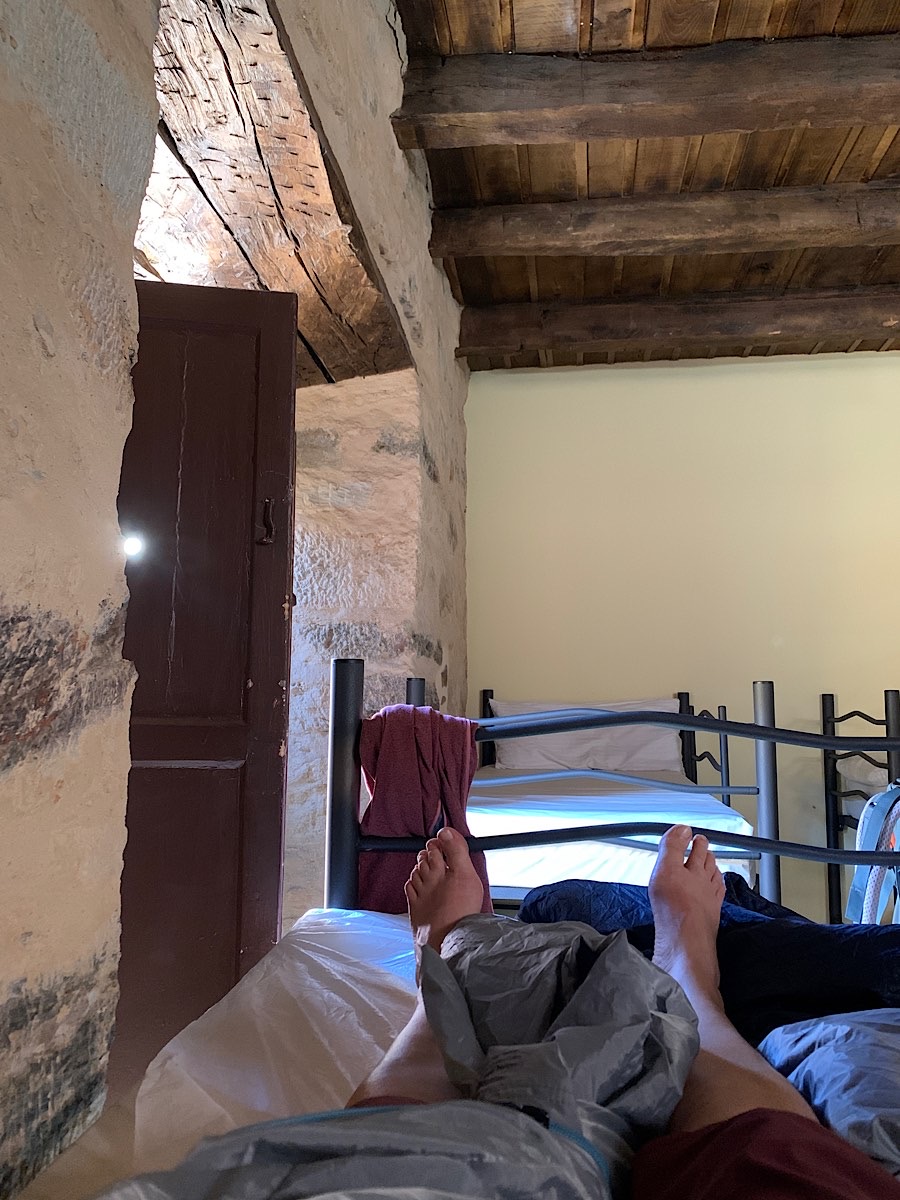
Around 9:30, a few Spaniards arrive and take the remaining empty beds in the hall. They talk a lot and loud, as if they were alone. Why can't they be considerate? And why do so many things drive me almost crazy anyway? It is mainly noises or sounds that I am sensitive to, and it has always been that way. I go ballistic at the sound of eating, especially when people are talking. When I was a child, sitting at a table with people whose chewing I could hear, especially if their jaws clicked or their throats made those strange grunting noises, it made me incredibly aggressive. I often couldn't continue eating myself because every bite would get stuck in my throat from the tension. When Americans talk, it is too much for me. The clacking of hiking poles on the floor is too much for me. The slapping of heels when someone is wearing flip-flops is too much for me. The fact that these things bother me at all is too much for me.
I would like to be more relaxed. Perhaps I should come up with a strategy for dealing with certain tense situations.
Distance: 31,4 km / Steps: 44982